New report: 85% of civilian harm was caused by governments - including those who signed up to stop it
Press Release | London, 11th June 2026, 13:00 GMT
At least 22,600 civilians were killed by explosive weapons across 65 countries in 2025, with state armed forces - not non-state groups - behind the overwhelming majority of attacks, a new report finds.
State armed forces caused 85% of the incidents that harmed civilians with explosive weapons in 2025 - including forces belonging to governments that had formally pledged to curb this very practice, according to the Explosive Weapons Monitor 2025 annual report, released this week. In total, at least 22,600 civilians were killed across at least 65 countries and territories, with states, not non-state groups, behind the overwhelming majority of attacks. The report tracks more types of weapons used against civilians, and more attacks on civilian infrastructure, than in previous years.
"The most alarming finding is that state armed forces were responsible for 85% of all incidents causing civilian harm last year. Governments, irrespective of the international agreements they have signed, are increasingly attacking civilians and aid workers," says Tom Shelton, Executive Director of Humanity & Inclusion UK.
Civilian deaths reported a 21% reduction from 2024's record high of 28,600, almost entirely as a result of ceasefires in Gaza and Lebanon in 2025. However, civilians remain the main victims of bombing in both conflicts.
“Bombing and shelling do not only kill and injure civilians - they dismantle the systems that keep people alive. Schools, hospitals, water pipelines, food markets, aid convoys: all of them are being hit, and hit more often. What shocks me most is the spread: 65 countries and territories were affected last year. This is no longer the exception - it is rapidly becoming the way wars are fought,” says Tom Shelton.
Air-launched weapons, increasingly drones, accounted for 67% of all incidents causing civilian harm. That trend is growing, with drone use in attacks on schools up 358% in Ukraine alone, and drone strikes on displaced people camps in the Palestinian Territory multiplied by 5 (from 64 in 2024 to 303 incidents in 2025).
Every sector is under attacks of explosive weapons and tracks got worse:
“Every destroyed school, hospital, market, water system, or humanitarian convoy represents far more than damaged infrastructure - it represents opportunities lost, futures disrupted, and communities pushed further from recovery. Long after the explosions end, civilians continue to live with the consequences of disrupted healthcare, interrupted education, damaged livelihoods, and the daily challenge of rebuilding their lives. For many, the consequences of explosive weapons become part of everyday life and suffering for years to come.” says Alma Taslidzan, Humanity & Inclusion’s Disarmament Advocacy Manager.
State armed forces were responsible for 85% of all incidents causing civilian harm - over 17,300 incidents (vs. 3,090 attributed to non-state actors). In five different contexts, state armed forces were responsible for more than 1,000 incidents: The Palestinian Territory, Myanmar, Ukraine and Russia.
The number of endorsing states of the 2022 Political Declaration on Explosive Weapons that were implicated in civilian harm rose from five to eight in 2025. They include Cambodia, Kenya, Morocco, Nigeria, Republic of Korea, Somalia, Türkiye, and the United States.
The number of countries harmed by endorsing states' explosive weapons use jumped from 5 in 2024 to 13 in 2025 - a sign that political commitments are in these cases not translating into changed military practice.
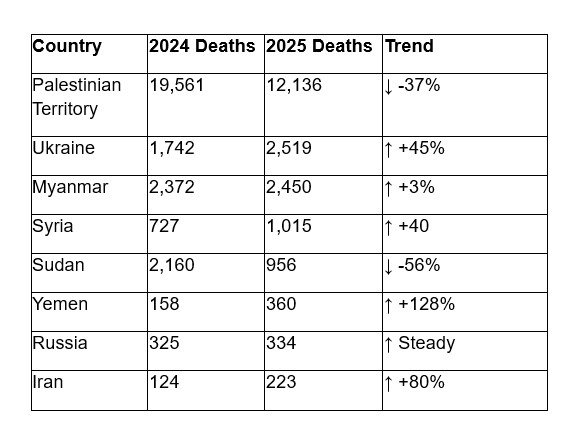
Here is the list of the countries most impacted by armed violence:
The report documents how online narratives following attacks on hospitals - in Gaza, Sudan, Myanmar, and Ukraine - actively eroded international humanitarian law protections.
Three recurring patterns emerged:
Allegations that hospitals were used by armed actors (used to normalise attacks),
Hostility toward humanitarian institutions like the UN and WHO,
And dehumanising rhetoric against ethnic or national groups.
The researchers of the report warn that "harmful online narratives more commonly emerged through selective interpretation and politicisation of real attacks" - not fabrication - making them harder to counter.
Spokespersons
Link to the 2025 Explosive Weapons Monitor report
About the Explosive Weapons Monitor
The Explosive Weapons Monitor is an initiative of the International Network on Explosive Weapons (INEW), a partnership of non-governmental organisations including Humanity & Inclusion, calling for action to prevent human suffering from the use of explosive weapons in populated areas.