

Mena is being supported by HI's rehabilitation team | © Khalil Nateel / HI
Mena is being supported by HI's rehabilitation team | © Khalil Nateel / HI
According to the latest figures from the World Health Organization, nearly 42,000 people in the Gaza Strip suffer from lifelong injuries. This represents a quarter of all reported injuries (167,376 people since October 2023). Among them, a quarter are children.
Fayez is 24 and his little sister, Mena, is 12. Before the war, their lives revolved around the family shop in the Al-Zaytoun neighbourhood, east of the Gaza Strip. Fayez helped his father in the store, Mena went to school. Their mother took care of the children.
“We lived simply, but happily,” Fayez tells us. “We were together, and that was enough for us.”
Since September, the brother and sister have been regularly visiting the Nahla prosthetics and orthotics centre set up by Humanity & Inclusion (HI) in Khan Younes. They come to learn how to walk with a prosthesis.
Last July, an Israeli missile struck the camp for displaced persons where they had taken refuge, in the Al-Mashaala neighbourhood south of Deir al-Balah. Fayez and Mena were seriously injured and had to undergo amputations. Another of their sisters was also seriously injured.
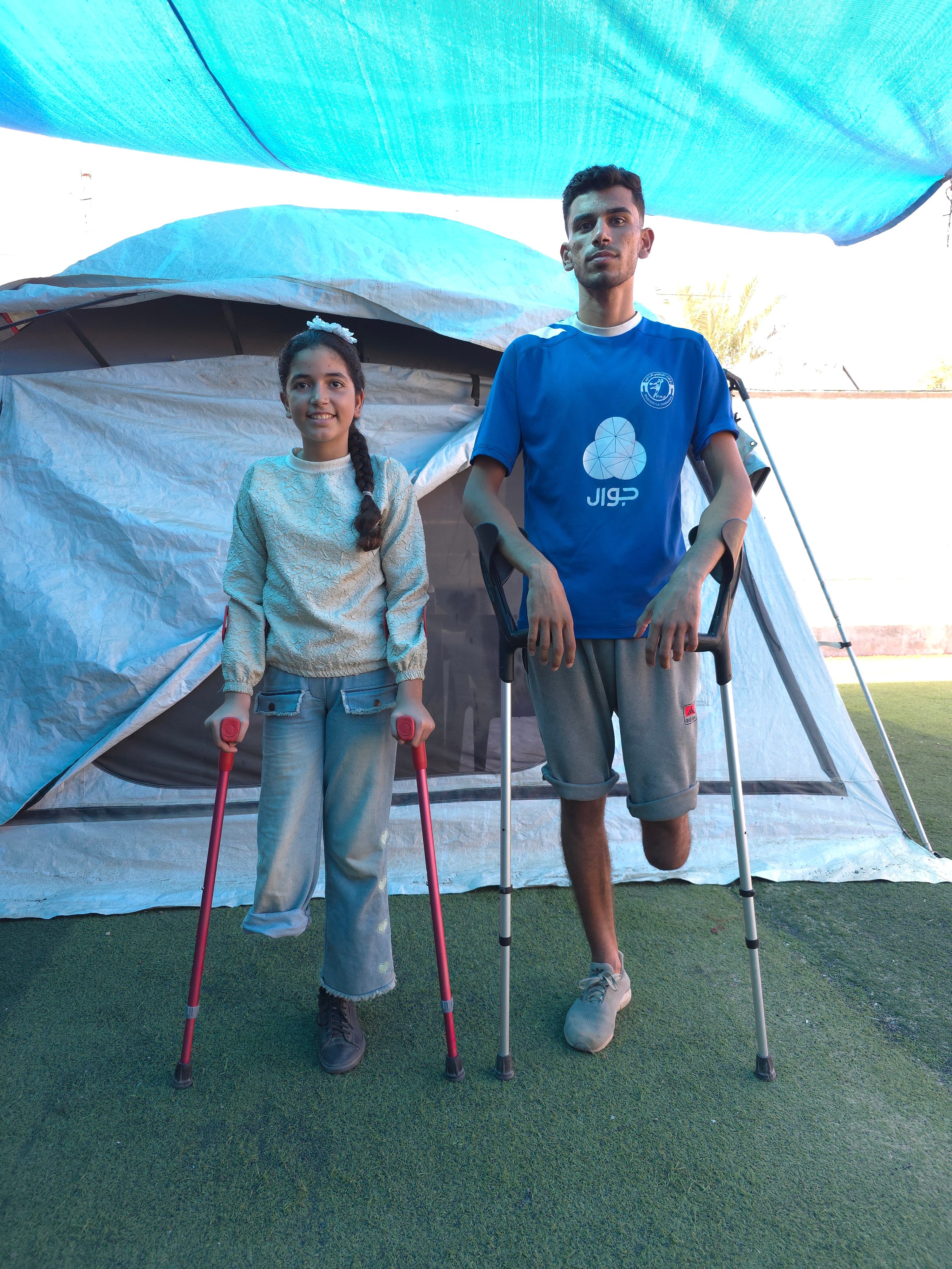
Mena and Fayez © Khalil Nateel / HI
After their surgery, Mena and Fayez were referred by Médecins du Monde France to HI to obtain prostheses and undergo rehabilitation. The accident brought the brother and sister closer together:
“Our relationship grew even stronger after the accident. We learned to rely on each other, and for the first time with our prostheses, I felt that we were truly moving forward toward a new life. HI helped us get back on our feet, both physically and emotionally,” adds Fayez.
When Mena received her prosthetic leg, her first desire was simple: to walk and be with her friends again. She was so excited to join them that she was all smiles:
“Walking alongside them made me feel alive.”
Mena also wants to return to a temporary school, like the ones set up by UNICEF during the conflict. But her injury still keeps her confined to her home. When she can walk properly with her prosthesis, she will return.
"Mena is wearing a below-knee prosthesis, which is a temporary prosthesis that we provided. It's her first day. She's a little tense, leaning forward slightly, but she has good posture, with just a little support from the physical therapist who is guiding her with her hands, just to reassure her, just in case. It's a simple aid, a safety measure, because these are her first steps, on her first day. It's like teaching a child to ride a bike: you hold them a little at first."
---
"The first attempts at using a prosthesis are made between parallel bars, sometimes with a mirror to correct posture. Some exercises are also carried out outdoors, on uneven ground, to test balance and alertness. Patients are encouraged to look straight ahead (rather than at their feet) to maintain correct posture and a smooth gait. Patients with trauma, such as those in Gaza, often need longer and more intensive follow-up, particularly in terms of adaptation and mobility recovery. But in Gaza, malnutrition and general fatigue complicate rehabilitation: patients lack energy, while rehabilitation requires significant effort."