

HI’s mobile clinic in the CBCA-REGO IDP camp, “Lac Vert”. | © S. Lazzarino / HI
HI’s mobile clinic in the CBCA-REGO IDP camp, “Lac Vert”. | © S. Lazzarino / HI
In North Kivu in Democratic Republic of Congo ( DRC), violent clashes between the Congolese army and the non-state armed group M23 have led to the displacement of over 2.7 million people1. The security and health situation in the camps hosting these displaced people is alarming; there is a desperate need for drinking water, shelter, protection and food. At the end of April 2024, 2.6 million people2 in the region were food insecure. The situation is critical. Extensive mobilisation is now essential to raise the funds needed to assist displaced civilians and ensure respect for their rights.
My name is Jean Bahati, I'm 60 years old and I come from Mushaki, in Masisi territory. I arrived here six months ago after I fled the war. I have nine children, five girls and four boys, aged between 26 and five. I came here with my whole family – all my children and grandchildren.
“This isn't the first time I've been here: it's the third time in 30 years that I've been displaced because of the war. The first time was in 1994 and the second in 2013. I remember there were many bullets. We were all running away and I fell and injured my back, pelvis and knee. It's because of the bombs that we become disabled.”
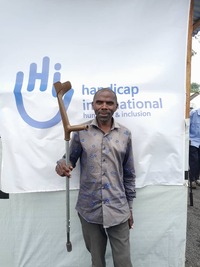 Before I met Humanity & Inclusion (HI)'s teams, I was walking with the help of wooden sticks. When I lived in Mushaki, I had crutches, but I lost them when I fled the war and the bombs. I had been using wooden sticks for 6 months.
In the camps, I heard about HI. I went to see the teams and now I'm satisfied because they gave me a crutch. I’ve thrown away the wooden sticks. I'm also getting treatment here with a physiotherapist who massages my leg.
I also took part in the psychosocial support programme. Before, I had problems remembering things, but thanks to the help I’ve received, things are starting to get better. My morale has improved. HI's support has enabled me to recover physically and psychologically. I also went to see HI’s partner, Première Urgence Internationale, to get some medicine.
I'd like to thank HI for its help, but we need the support to continue. There are not just health problems here; there’s hunger too.
"We're in the desert here. Back home, we had fields and we could grow crops. I used to be a farmer, look at my hands. Here, it's very difficult. We don't work. People need to be informed and mobilised on a massive scale so that the people occupying our land leave and we can get our fields back."
We have not offended God. We are Congolese. We just want to live in safety, peace and freedom.
HI is deploying mobile clinics in North Kivu to improve access to healthcare and provide medical and psychosocial assistance to people displaced by the conflicts. Between February and April 2024, more than 7,000 people were informed about mental health and 702 people received psychosocial care. Training in psychological first aid and active listening was also provided to community relays. In the CBCA-REGO "Lac Vert" refugee camp, 590 people also received physical and functional rehabilitation care. Lastly, during this same period, HI distributed 381 walking sticks and crutches, 900 kits containing essential household items such as cooking utensils, and 168 hygiene kits including soap and sanitary protection.