

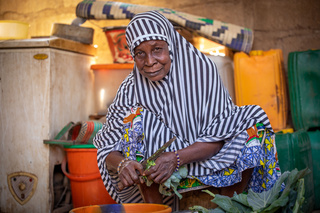
Fadima Hamidou proudly showing the harvest from the shared garden in Sebba, Burkina Faso. | © Imédia Sarl / HI
Fadima Hamidou proudly showing the harvest from the shared garden in Sebba, Burkina Faso. | © Imédia Sarl / HI
Insecurity and violence are rife in the cross-border region between Burkina Faso and Niger. Food insecurity and the lack of economic opportunities, especially for young people, are weakening what are already very impoverished populations in these regions. To help them, HI and its partners – the Nodde Nooto association, the Burkinabe Red Cross Society, the Spanish Red Cross, Doctors of the World Spain, Veterinarians Without Borders Belgium, the NGO Karkara, Doctors of the World Belgium and SongES Niger – launched the RECOSA project.
 The RECOSA project aims to strengthen the resilience and social cohesion of vulnerable populations in the cross-border regions of Burkina Faso (Sahel region) and Niger (Tillabéri region). It was through this project that the people of Sebba, a town in north-eastern Burkina Faso, were supported.
Fadima is crouched in her kitchen, smiling at the camera. She holds a knife in her hand and chops vegetables over a basin. Many of those who live in Sebba are internally displaced people who have had to flee violence and conflict. Given the prevailing insecurity in the region and on the country’s roads, there is no guarantee that supplies will reach the town.
“We were forced to settle here, and our families were starving. We were no longer being supplied with food and other goods by lorry. It was even impossible for us to get around. Some people died because of this famine. We have seen a great deal of suffering, made worse by the violence,” says Fadima Hama, who lives in Sebba.
Thanks to the RECOSA project, 75 Sebba households have been trained and equipped to create home gardens and shared gardens, an initiative they immediately embraced. The project helps people establish plant nurseries and offers training courses in how to prick out plants and in best market-gardening practices.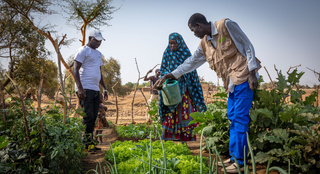
“The garden work has been a great success. I started the project when my morale was at rock bottom. At the time, I was only eating wild leaves and fruits... We started growing cabbages and onions. The RECOSA project then helped us by giving us seeds. It’s been a great success for us: gardening is good for me and those around me. With the money I make from market gardening, I can buy soumbala, a condiment, and stock for cooking,” says Fadima Hamidou, who also lives in the village.
“The garden really is very useful. Since we’ve been tending it, we’ve been eating a healthy, balanced diet, and our sauces are full of goodness. We eat well and often share with our neighbours,” adds Fadima Hama.
The project to strengthen the resilience and social cohesion of vulnerable populations in the cross-border regions of Burkina Faso (Sahel region) and Niger (Tillabéri region) was launched in December 2019 and will run until December 2023. It is coordinated by HI and implemented by the organisation and its partners: the Nodde Nooto association, the Burkinabe Red Cross Society, the Spanish Red Cross, Doctors of the World Spain, Veterinarians Without Borders Belgium, the NGO Karkara, Doctors of the World Belgium and SongES Niger. The project is funded by the European Union, and has achieved the following: