

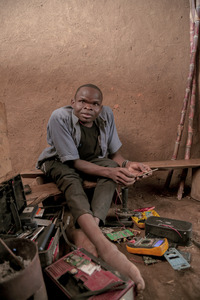
Abraham Artema lives in Kyangwali refugee camp. | © Infomercial Media / HI
Abraham Artema lives in Kyangwali refugee camp. | © Infomercial Media / HI
In the Kyangwali camp in Uganda, more than 20,300 people are living with disabilities and one in two families has at least one disabled member. Humanity & Inclusion (HI) has provided mental health support as well as physical and functional rehabilitation services to more than 2,300 people. This support includes physiotherapy sessions as well as mobility aids distribution, such as walking sticks and wheelchairs.
Abraham Artema is 31 years old and comes from the Democratic Republic of Congo. He now lives in the Kyangwali refugee camp where he runs a workshop repairing watches, radios, telephones and other appliances
Abraham is being accompanied by Medical Teams International, HI’s partner, for his health problems. This NGO referred him to HI for physioptherapy. HI has provided him with a tricycle and exercises to reduce the pain he was experiencing.
"My disability is in my legs; I'm unable to move around on my own. HI provided me with a tricycle. Now all I have to do is get on it to go wherever I want. I also received a walking frame so that I can stand up. Thanks to these aids, I can get to work," says a delighted Abraham.
 Abraham then met with an HI psychologist for emotional support. During his first interview, Abraham expressed feelings of loneliness and inadequacy. He confided in the psychologist about the fears he was experiencing because of his financial difficulties, as well as the concern he felt about the attitude of certain people towards his disability.
"I used to feel very bad about myself and I was afraid to speak openly in front of others for fear of being judged."
During his sessions, HI’s psychologist helped Abraham to reduce his stress levels, manage his anxiety, recognise his fears and understand his emotions. Thanks to this support, he learned to identify his negative beliefs and replace them with positive, self-affirming thought patterns.
"The sessions helped me to overcome my internal conflicts and appreciate what makes me unique. I learnt that I had a choice, that I could take control of my destiny despite my disability, and that's when I started to invest seriously in my work," he concludes, happily.
The InCharge project, implemented in Uganda between August 2021 and July 2024, was led by Medical Teams International. A total of over 5,100 people were supported in the Kyangwali and Kyaka camps, of which 1,400 through rehabilitation and 3,700 through mental health support.