

Domingo, a former taxi driver, with his family. | © Maud Bellon/HI
Domingo, a former taxi driver, with his family. | © Maud Bellon/HI
Humanity & Inclusion's teams are preparing to launch a potential emergency response to super typhoon Mangkhut, which hit the Philippines on the night of Friday to Saturday.
HI regularly works with people affected by natural disasters in the country and launched a large-scale response in November 2013 to typhoon Haiyan, which affected more than 14 million people and claimed more than 6,000 lives.
Mark-Kevin, the eldest of a family of eight children in Giporlos, on the south coast of Eastern Samar, has cerebral palsy:
"In Giporlos, it was already raining a lot and everyone was running."
"My neighbours carried me in their arms and someone else carried my wheelchair."
"The wind was blowing so hard, I didn't feel safe. When the water started to rise, everyone went up to the third floor and they had to carry me.
We didn't know if the building would hold. I was very scared."
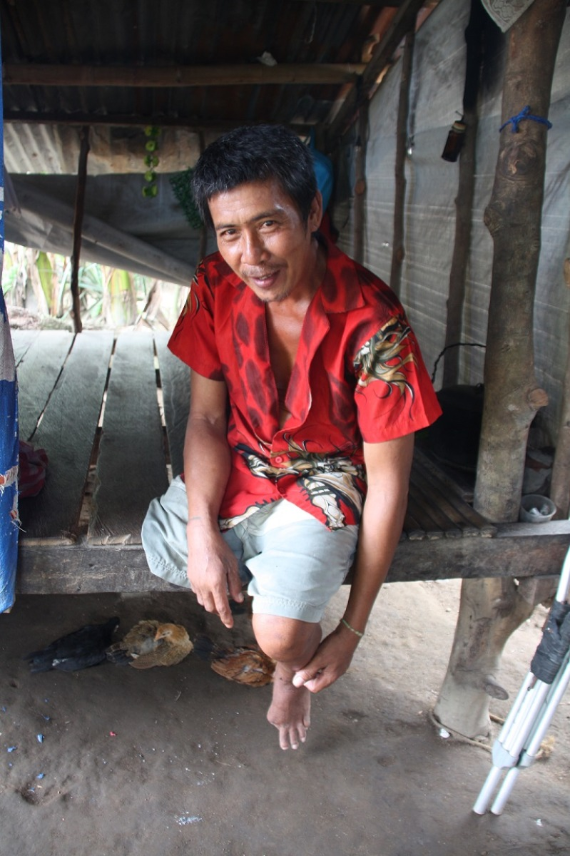 Oscar, head of the family, Barangay de San Diego:
"It was a total disaster. Our house was destroyed by coconut trees. It killed all my animals, my only source of income."
"I lost a leg a few years ago due to Buerger's disease. After the typhoon, it was hard to walk up the slope. HI gave me some new crutches and arranged for me to have rehabilitation care. I was also given some pigs to breed so I could earn my living that way."
Domingo, a former taxi driver in Tacloban:
“Our house was completely destroyed by typhoon Haiyan.
"When I was cleaning up the debris, I hurt my leg. I didn’t get it treated straightaway and ended up not being able to walk."
"I’d been vaccinated for tetanus, but it wasn't enough. I had to be amputated at the knee. It was a disaster."
"Fortunately I came across HI’s teams, who gave me crutches and arranged for me to attend rehabilitation sessions.”